Thursday, August 1, 2013

A Short Story: Divine Benevolence

For a change from Prem Chand, readers might  read this story of mine  written many years ago  but still, if not more, relevant today.                                                                                                                                                   


DIVINE BENEVOLENCE
by T C Ghai

            Completely fed up with the promises of their rulers the poor of India decided to send a petition to Lord Vishnu.

            At a meeting, a representative assembly of the underdogs from all corners of Bharat resolved, with one voice, to address an appeal to the Lord of Creation. But the question ‘who was the Lord of Creation’ generated much heat. A large number had no doubt about Lord Vishnu being the Supreme Ruler. Some, however, argued that it was Brahma who was the Master of the Universe; others that it was Shiva; some named mother Kali; and yet others Allah or Jehovah. Scores of minor and subservient deities or even demons were also projected, in their turn, as the Lord of Creation.

            Finding the House in a violent disagreement somebody suggested voting and a majority decision. On this a venerable member counselled that, since, in the event of voting, Lord Vishnu was certain to be elected, it would be an act of folly to force a division at such a critical juncture. The advice was generally welcomed. Even then a few members voiced the apprehension that Lord Vishnu, being a deity of the majority community, might discriminate against the minorities. But eloquent protestations of the underlying unity of all the religions and the universality of divine benevolence finally subdued all dissent.

            A charter of demands was prepared, a delegation elected and the august Assembly adjourned after expressing the hope that Lord Vishnu would deliver them from the yoke of the present-day rakshasas, as he had done again and again by coming down to the Earth as an avatar.

            The delegation then set out on its journey towards the abode of Lord Vishnu. But instead of reaching  Ksheer Sagar, the Sea of Milk, said to be the abode of Lord Vishnu, the members of the delegation found themselves at the Gates of Heaven.

            ‘Who’re you?’ one of the guards there asked them sternly. 
          
            ‘Sir, we’re going to the abode of Lord Vishnu, and have lost our way. Please tell us the way to the Sea of Milk.’

            ‘What’s that?’ the guard asked.

            ‘The abode of Lord Vishnu,’ replied a delegate.

            ‘Who told you?’

            ‘We’ve always known it.’

            ‘Then you must all be fools. Where’ve you come from?’

            ‘From Bharatvarsha.’

            ‘Bharatvarsha? We’ve never heard of such a place.’

            The delegates could not believe their ears. Never heard of Bharatvarsha!

            ‘Bharatvarsha is the greatest country on Earth,’ one of the delegates proudly proclaimed.

          ‘It must be really great to have ignorant beggars like you. Somebody has been fooling you there. You’re lucky you have reached here. This is the abode of Lord Vishnu,’ he said, pointing his hand towards Heaven.

            The delegates were overjoyed to hear this. Their leader then moved forward and requested the guards that they should be allowed to go in to see the Lord.

            ‘Why do you want to see Him?’ asked the officer of the guards.

            ‘We’re representatives of the poor in Bharatvarsha. We’ve come to the Lord with a petition on their behalf,’ the leader of the delegation explained.

            The officer’s demeanour hardened at the mention of the word ‘poor’ and he immediately declared, ‘You cannot see Him.’

            ‘Why?’ they asked in one voice.

            ‘Because we can’t allow stinking beggars like you to enter Heaven. Go back wherever you’ve come from,’ the officer retorted harshly.

            ‘But the Lord would not refuse to see us. He’s our Preserver,’ urged the delegates.

            The officer was now red with anger. ‘Get away from here at once, or we’ll throw you away,’ he thundered at them.

            This menacing posture of the officer baffled the delegates completely. They just didn’t know how to appease or circumvent his hostility. They were half inclined to turn back  when they remembered crores of hungry, naked and roofless Indians living without hope. They moved aside to confer. One of them whispered that they should try to win over the guards by offering the silver bangles and anklets worn by the woman delegate. The lady winced at the suggestion. These were borrowed ornaments and she was unwilling to lose them. But her companions prevailed upon her by arguing that her sacrifice would not go uncompensated by millions of their fellow countrymen, whose representatives they were.

            One of the members then went up to the officer of the guards, took him aside and talked to him in whispers. This had its effect. The officer agreed to carry their petition in. He, however, would not let them in because, he told them, no one was allowed to enter Heaven without an express permission from the Lord.

            He directed them to camp at some distance from the gates of Heaven, out of sight of the guards, and wait till a reply was received from within.


            When no one came to summon them even after hours of waiting, a few of them went to the guards to find out if any reply had been brought for them. The officer shook his head and advised them to be patient; they could not hope for such a quick response because their petition would be scrutinized at many stages before it was finally placed before the Lord. It all depended, he said, pointing his finger vaguely towards Heaven, on the officials there who had their own conception of what was important or urgent or otherwise. If they detected urgency in anything, they might allow an appointment in a fortnight, otherwise it took months and sometimes years before any response came from them. A member ventured to point out that nothing could be more desperate than the fate of millions of poor people of Bharatvarsha. At this the officer replied that he could say nothing on the subject, he himself being a total stranger to all that went on inside. He advised them to allow the matter to take its own course; otherwise the officials might get provoked, and misrepresent their case, or just sit on the petition and never forward it to the Lord.

            The members hung their heads in resignation and walked away to their camp, hoping that the sense of urgency expressed in their memorandum would not be lost upon the people inside.

The members of the delegation had set up their camp in the open ground far from the entrance to Heaven. In the evening when a cold wind began to blow they realized that, with the meagre clothing they had with them, they would be frozen to death if they received no help from Heaven. It being too late to ask for help now, they spent the night signing the Lord’s praises and dancing round the fire they had lit to cook their food.

            The next morning they requested the officer of the guards to provide them with food and some protection from the cold. As it was not known how long they would have to wait, they feared they would perish with cold and hunger if left to fend for themselves. The officer simply waved aside their fears. He assured them that they would never die because anyone who ever came there as a supplicant was exempt from death while his petition was being heard in Heaven. He cited an instance where a person had to wait, without food and shelter, for two years before his petition was finally rejected. They had heard him howl and groan, but he had survived the ordeal.

            On being asked why they could not be housed inside and provided with food, the officer replied that it was an iron law that only those who had proved themselves deserving were received within. Some delegates wondered whether it would not be possible for them to enter Heaven by bribing the guards, but since they had nothing with which to inveigle them they kept quiet. All of them, however, became mournfully conscious of their sinfulness that denied them the hospitality of Heaven even for a short while. They resolved to make use of their time to propitiate the Lord through regular prayers.

            Days changed into weeks, and weeks into months. There was nothing to indicate that their petition had been presented before Lord Vishnu. Once that was done, there would be no delay; Lord Vishnu could not be so cruel as to leave them suffering like that. The guards were either unwilling or unable to provide them with any information on the progress of their petition. They could, therefore, do nothing except wait till the officials within were pleased to think of them.

            In the meanwhile, hunger and cold did not prove to be murderous as they had imagined; they were able to endure them quite easily, being no strangers to these hardships on Earth where these were their constant companions. The guards, who had seen other people writhe and howl under similar conditions, marvelled at their capacity to suffer so much without complaint.

            After a hundred days of waiting they were summoned before an official from within. He told them that he had been sent by the most trusted minister of the Lord to receive them and redress their grievances.

            The leader of the deputation told him that they had come to see the Lord Himself.

            ‘I know that,’ replied the official curtly, ‘it is impossible for you to get an audience with Him. He is preoccupied with affairs of great importance and has no time for petty things.’

            ‘But our problems are not petty,’ cried one of the delegates.

            ‘That’s how it may look to you. But think of the Lord. He has to manage the affairs of millions of worlds. You are lucky that we’ve been able to think of your petition so soon. You might have waited and waited. Now at least you can speak out and we shall do our best. It is really unnecessary for you to stay and try to see the Lord. I’m here to help you.’

            The delegates had not come for this. To have come from so far, to have suffered so much, only to be turned away from the gates of Heaven by a small official!  No, they were not prepared for this. But they did not know how to convince this man. Then, all of a sudden, the lady delegate stood up with folded hands and said, ‘Sir, we’re grateful to you. But we’ve come here to see the Lord, and we shall not go away without his darshan, even if we’ve to wait for years. Please go and tell this to the Lord.’

            There was a murmur of approval from all her companions.

The official seemed ruffled by this show of tenacity. He had been asked by his Chief to put these people off. The Chief wanted to prevent their meeting Lord Vishnu because he had admitted to Heaven, through questionable means, a large number of people from their planet and also barred the entry of many who were really deserving of a place there. He feared that the truth behind these dubious transactions would come out if the Earthlings were allowed to meet Lord Vishnu; and that would bring down His wrath upon him. The official, however, felt that he could do nothing against the strong resolution of these people. If they stuck to their word, which seemed likely, the Lord was sure to notice them on one of his visits around the place, and that would create difficulties for him too. Moreover, why should he, he thought, help to cover up the misdeeds of his Chief, who seldom shared with his subordinates the offerings he accepted from all those undeserving aspirants for Heaven.  He even felt some satisfaction at the possible discomfiture of his Chief.

            A broad smile appeared on his celestial countenance as he addressed the Earthlings thus:

          ‘Friends, I’m happy that you have such eagerness to meet the Lord. I was only trying to gauge the depth of your love for Him. How can the Lord refuse to meet His steadfast devotees? You may have to wait for some more time but, rest assured, your devotion will qualify you for His darshan.’

            ‘We’re prepared to wait,’ they chanted in voices weak with hunger and choked with emotion. Encouraged by this cheerful prospect, one of them even spoke of the unbearable hunger and cold that was their present lot.

            The official excused himself, saying he could do nothing about it, and walked in through the gates. The Earthlings cast gloomy looks across the Heavenly entrance to see where he went, but everything, except the high gilded domes of Heaven, was clouded in a deep mist. They could form no idea of what went on beyond that thick veil.

            Three weeks later they received, through the officer of the guards, the following note sent by the highest authority entrusted with the affairs of their planet.
           
‘After a careful scrutiny of the petition made by some Earthlings we feel that it is not necessary to bother the Lord with such trivial matters. We appreciate the courage and devotion with which they have undertaken such a hazardous journey to Heaven to acquaint us with the affairs of our subjects in Bharatvarsha. But we hope they realize that it is not possible for us to accept as true, on such a flimsy evidence and without sufficient warrant, all that has been stated in their petition. We have therefore decided to appoint a commission of enquiry to go into the alleged misdeeds of some and miseries of many in their land. The commission will, after its investigations, suggest measures, if indeed they are needed, to ameliorate the lot of our subjects. Nothing can indeed be dearer to us than the perpetual well being of all our peoples. But they must realize that it is impossible for us to accept a handful of people as representatives of crores of our subjects, for we believe that anyone who has a grievance can come on his own to seek justice here. The gates of Heaven are open to everyone.
           
However, in order to compensate for the hardships endured by the members of this delegation we are prepared to reward them suitably. The reward would include the guarantee of a happy life on Earth, freedom from want and misfortune. It may even include acceptance into Heaven later.’

            The note raised a big controversy among the delegates. There were many who were prepared to accept the argument that they could not represent others; so if they had failed to get anything for others, why should they spurn what was being offered to them. Others could not accept this. They argued that, having come here solely as representatives of their brethren, they could not go back with their own pockets filled, but empty-handed for the rest.

            There were two or three who were quite unconcerned with such questions. Their contention was that, having come so far, and having suffered so long, they must not go back without the Lord’s darshan. At least one among them suspected some deep conspiracy to prevent their meeting with the Lord. When others protested that such a thing could never happen in Heaven, he silenced them by saying that if the guards could be bribed, why not others.

            After a prolonged discussion it was decided to make one final attempt to secure an audience with the Lord. Accordingly, they informed the officer of the guards that they would go away only at the bidding of the Lord Himself, otherwise they would prefer to perish there rather than turn back without His blessings. The officers warned them that they might even lose, through their obstinacy, whatever little was being offered to them. They, however, stuck to their resolve.

            Another thirty days passed before they were summoned before the Lord of Creation.

            Lord Vishnu smiled at them as they lay prostrate before Him. ‘Arise, my children. Tell me how are my subjects in Bharat. What has impelled you to seek me through so much hardship? But first, tell me why do you look so lean, so starved, so sullen? Why are you dressed in rags?’

            Tears overflowed their cheeks as they listened to the soothing words of the Lord. They were face to face with Him! He was talking to them so lovingly! Surely all their sufferings would now end. Gradually they raised themselves and stood with their eyes riveted on the Lord’s refulgent glory.

            Some time elapsed before the Earthlings realized that the Lord had spoken to them. Their leader moved his lips in an attempt to answer. But his courage failed him. Lord Vishnu divined his hesitation and commanded: ‘Speak, without fear of anyone.’

            ‘O Lord,’ the leader began, ‘whenever Earth has quaked under the weight of sinfulness, you have always come down to rescue your humble and suffering devotees. Such a time has come once again. Bharat, that was once like Heaven, that was once the land where even gods longed to be born, is in a sad plight. It is groaning under the tyranny and injustice of new rakshasas. Crores of people have nothing to eat, nothing to wear. Our children grow up only to struggle, day and night, for crumbs of bread. Instead of blood, poverty and hunger flow in our veins. It seems we have been hungry for ages. Crores amongst us have forgotten what it is to have a belly-full of food. This had never happened in the worst of times. Never in the past did Bharat have so many people living like worms and insects, and rulers so hard-hearted, so forgetful… They swear by us. They declare that they rule over us with our consent, and work day and night to lessen our sufferings. Yet during the last thirty years our miseries have only multiplied.’

            Lord Vishnu lifted his palm to interrupt him. ‘Peace, my son. I am astonished. People coming from Bharat have told me that all is well there. Everyone has plenty to eat and drink. They live in beautiful palaces, and lack nothing. And you are telling me that crores of people live like worms! I cannot believe this.’

            The words of the Lord hit them like a thunderbolt. The Lord also telling that He did not believe them? How could He be ignorant? He must be putting them on trial.

            ‘Lord,’ their leader moaned, ‘You are all knowing. Nothing can be hidden from You? How can You disbelieve us? Even a straw does not move without Your command. Do not try our endurance and devotion any further. We’ve suffered enough.’ Saying this he broke down completely.

            Deep furrows appeared on Lord Vishnu’s heavenly brow. He closed His eyelids and tried to concentrate on something. A tiny planet swam before Him. A moment’s introspection revealed to Him the entire truth about this miserable little ball. This is what happened, He reflected, with Godly dismay, when one put too many irons into the fire. He had, in His maniacal fascination for creation, gone on creating worlds and beings, leaving them to these agents to mal-administer. And they had messed up the whole thing through their indifference, indolence, greed, and personal jealousies. To satisfy their vanity of being worshipped as gods they had created factions among their subjects; incensed them to wage bloody wars, and perpetrate heinous crimes; infected them with frightful diseases and pestilences; held back rains when rains were desperately needed; caused floods and sent down hails to destroy their crops and cattle; caused earthquakes to raze cities and bury alive thousands of their subjects. They had inveigled the powerful and the cunning among the mortals into inventing falsehoods to deceive the weak and the simple-minded, so that they could accept their hardships and miseries as manifestations of divine displeasure, and offer sacrifices and burn incense at their altar to tickle their godly nostrils. They had even infested Heaven with their toadies and most undeserving scoundrels by receiving the meanest gratifications, and kept out of Heaven the most deserving of men. If only He had not been carried away by His enthusiasm for Creation, these Earthlings would not be here with their silly complaints...

            He was so moved by the spectacle of human misery on this planet that He decided to put an instant end to it by blowing up the whole planet out of existence…but the next moment He remembered that this was after all only a play, a grand play – all this pain and pleasure, hunger and satisfaction of hunger, nakedness and kingly wear, crowded stinking huts and magnificent palaces, Hell and Heaven. No one really suffered, no one was happy; no one fell ill and no one recovered; no one died for no one was born. It was a Fantasy He had created for His own delight.
           
Why not, then, allow this play to go on? Why interfere, and why not allow it to work to its own logical conclusion? It would be fascinating to see the extent to which the perversity of these two-legged creatures could carry them. He decided to keep a constant watch on this planet, but without interfering in all that went on there. However, His immediate task was to reassure and send these people away.

            He opened His eyes, cast a benign look upon the Earthlings and spoke in a  most mellifluous voice: ‘My children, forget all your fears. I know all that is happening in Bharatvarsha. The evil and the wicked cannot escape punishment. They will continue to rule over Earth for some more time, but not for too long. And when the Time comes I shall not fail to deliver the virtuous. Then all your sufferings would come to end.  Now, go back home in peace, and pass your days chanting My name. Do not ever lose faith in Me, even at the worst of times. I shall not fail to rescue you at the appointed hour.’
           
Tears of joy rolled out of their eyes as these words of the Lord fell on their ears. Their mission had succeeded beyond all their expectations. All of them, once again, lay prostrate before Lord Vishnu, murmuring something through their tears. Slowly they got up on their feet and marched out.

Lord Vishnu heaved a sigh of relief.
…


Tuesday, July 2, 2013

Premchand's story 'Shatranj Ke Khiladi' in English

Here is my translation of Premchand's short story 'Shatranj ke Khiladi'. This is sixth of the most popular short stories of Premchand translated by me  and posted on this blog. Hope lovers of Premchand would enjoy reading it. I have used the Hindi version of the story for my translation.


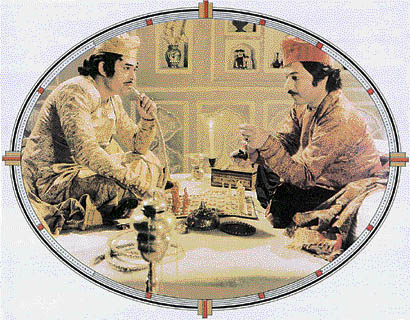
       A scene from Satyajit Ray's film 


                 The Chess Players

                  (शतरंज के खिलाड़ी)


It was in the times of Wajid Ali Shah. Lucknow was drowned in sensuality. The big and small, the rich and the poor – all were sunk in it. Some were engrossed in dance and music; some just revelled in the drowsiness induced by opium. Love of pleasure dominated every aspect of life. In administration, in literature, in social life, in arts and crafts, in business and industry, in cuisine and custom – sensuality ruled everywhere. The state officials were absorbed in fun and pleasure, poets in descriptions of love and separation, artisans in zari and chikan work, businessmen in dealings in surma, perfumes and cosmetics. All were drowned in sensual pleasures. No one knew what was happening around the world. Quail fights were on. Rings were being readied for partridge fights. Somewhere the game of chausar was being played, with its attendant shouts on the winning throw. Elsewhere a pitched chessboard battle was on.  From the king to the pauper – all were engrossed in these pleasures. So much so, that if beggars received money in alms, they preferred to spend it on opium or its extract rather than bread. ‘Playing games like chess or cards or ganjifa sharpens the mind, improves mental faculties and helps in solving complex problems.’ Such arguments were being forcefully advanced. (People subscribing to this thesis can be found even today.) So if Mirza Sajjad Ali and Mir Roshan Ali spent most of their time sharpening their wits, how could any thoughtful person take exception. Both of them were hereditary Jagirdars, free from the worries of a livelihood; they enjoyed their good food without having to work at all. What else could they do?

Every morning, after breakfast, both the friends would spread the chessboard, set up the pieces and  engage themselves in the tactics of chessboard warfare. They would forget whether it was noon, afternoon or evening. Repeated messages from inside that food was ready were ignored, and the cook was forced to serve food right there in the room, as the two friends continued their play. There were no elders in Mirza Sajjad Ali’s family; as a result the game was played in his dewan khana. However, members of Mirza’s family were far from pleased. Not to speak of the family, even the neighbours and servants made uncharitable comments: ‘This is an inauspicious game and can ruin families. God forbid that anyone should get addicted, for it makes a person unfit to do anything.  It’s a serious disease.’ Mirza’s begum was so hostile to the game that she would seek out occasions to berate her husband. But she rarely got this opportunity. The game would begin while she was still asleep, and Mirza would come inside only when she had gone to sleep. However, she would expend her ire upon the servants. ‘Are they asking for paan?  Tell them to come and take it themselves. Have they no time for food? Go and throw it to them. Let them eat or cast it to the dogs.’ But face to face she was helpless. She wasn’t resentful against her husband so much as against his friend, Mir sahib. She had named him Mir, the spoilsport. It is possible Mirza, to save his own skin, also threw all the blame on Mir sahib.

One day the begum had a severe headache. She said to her maid, ‘Go and call Mirza sahib. They should go and bring medicine from a hakim. Run, be quick.’.  Mirza sent the maid back saying he would follow. The begum was hot-tempered. She lost her patience. How could her husband play chess while she had a headache?  Her face became red with anger. She said to the maid, ‘Go and tell them to come immediately, or I shall go to the hakim by myself.’ Mirza was in the midst of a very absorbing game. Mir sahib would be checkmated just in two moves. He spoke in irritation, ‘Is she on her last breath? Why can’t she wait?’  

Mir sahib interjected, ‘Why don’t you go? Women are delicate things.’

Mirza retorted, ‘Oh yes, you want me to go because you’re facing defeat in the next two moves.’

Mir said, ‘My dear, don’t be under any illusion. I have thought of a counter move that’ll turn the tables on you. Go and attend to her. Why are you hurting her?’

‘I won’t go until I have checkmated you.’

 ‘I won’t make any moves. Go and attend to her.’

 ‘My dear, I’ll have to go to a hakim. There’s no headache. This is just pretence to harass me.’

‘Whatever it is, you’ll have to go.’

‘All right. Let me make one more move.’

 ‘Not at all. I won’t touch my pieces until you have gone and talked to her.’

When Mirza sahib went in, the begum changed her tactics and said, groaning with pain, ‘You love this wretched game so much that you don’t care even if I am dying. What kind of a man are you?’

Mirza replied, ‘What could I do? Mir sahib wouldn’t let me go.’

‘Does he think all are as idle as he. He too has a family. Or has he finished them off ?’ 
 
‘He’s such an addict. Whenever he comes I am forced to play.’

‘Why don’t you drive him away?’

‘He is my equal in age, and two fingers higher in rank. I have to oblige him.’

‘Ok, then I shall drive him away. What if he is offended? Does he feed us? Oh Haria, go and pick up the chessboard. And tell Mir sahib that Mirza sahib won’t play anymore. Tell him to go home.’

‘No, no! Don’t do anything of the kind. Would you have me humiliated?  Oh Haria, stop. Don’t go.’

‘Why don’t you let her go? Anyone who stops her will drink my blood.  All right, you stopped her. Let me see how you stop me.’

Saying this begum sahiba advanced angrily towards the dewvan khana. Mirza’s face turned pale. He began to plead with her. ‘For God’s sake. I bind you in  the name of Hazrat Hussain. You would see me dead if you went there.’ But the begum was in no mood to listen. She walked up to the dewan khana, but she stopped. She wouldn’t go in, in the presence of an outsider. She looked in but there was no one there. Mir sahib had displaced a few pieces on the board and had gone out for a stroll to show his innocence. The begum went inside and overturned the chessboard, threw some chessmen under the dewan and a few others out through the door. Then she shut the door and bolted it from inside. Mir sahib saw the chessmen being thrown out and heard the sound of bangles, and the door being bolted. Realizing that the begum was inflamed he slnnk away.

Mirza sahib said to his begum, ‘You’ve been terrible.’

The begum retorted, ‘If Mir sahib comes here, I shall drive him away from the doorsteps. Had he devoted himself to God like this he would have become a saint. You keep playing chess and I remain enslaved to the domestic chores. Are you going to the hakim, or are you still unwilling?’

Mirza came out, but instead of going to the hakim he went straight to Mir sahib’s and narrated the whole story.

Mir sahib replied, ‘When I saw the chessmen being thrown out, I understood everything and ran. She seems so hot-tempered! But you have pampered her so much. This is not good. Why should she bother what you do outside? It is her duty to manage the household. Why should she worry about what you do?’  

‘Never mind,’ said Mirza, ‘Where shall we play now?’

“Why worry? This is a big house. We can play anywhere here.’

‘But how shall I make the begum accept this? When I sat at home she kept on creating trouble. Now if I sit here she won’t let me breathe.’

“Let her shout. She’ll get used to it in a few days. But from now onwards be a little tough with her.’

2

For some unknown reason Mir sahib’s begum preferred to have her husband away from home. That’s why she never objected to Mir sahib’s love of chess, so much so that if Mir sahib delayed going out she would remind him. Because of this Mir sahib was under the illusion that his wife was very courteous and sober. But when the chessboard was spread in the devan khana and Mir sahib stopped going out, the begum became edgy. Her freedom was curtailed. She hardly had any chance to have a glimpse of the outside.

And there was murmuring and whispering among the servants. Up till now they had sat idle, warding off flies. They were never bothered by guests. But now they had to take orders the whole day. Now to fetch paans, now sweets. And the hookah kept smouldering like a lover’s heart. They would go and complain to begum sahiba. ‘Mirza sahib’s chess has become a nuisance. Running about to execute orders, our feet are blistered. What sort of a game is this that goes on from morning till evening! It should be enough to play a game for an hour or two. But we can’t complain. We’re his slaves and have to obey the orders. But this game is evil. The person playing it never prospers. A misfortune is bound to fall upon such a house. So much so that we have seen whole neighbourhoods being ruined one after the other. Everyone in the neighbourhood is talking about it. We’re his faithful servants and don’t like to hear him maligned.’ On this begum sahiba would say, ‘I also don’t like this. But he doesn’t listen to anyone. What can I do?’

In the neighborhood there were a few people of the old school. They had begun to foresee many unhappy consequences. ‘Nothing good will come of it. When our aristocracy is behaving in this manner, God alone can save the country. This kingdom will be ruined because of this game. It’s an evil sign.’

And indeed there was great disorder in the kingdom. People were being robbed in broad daylight. There was no one who could listen to their complaints. All the wealth from the countryside was being sucked into Lucknow and blown on prostitutes, buffoons and in sensual pleasures. The blanket of debt to the English Company was becoming wetter and heavier every day. Because of the absence of good administration taxes were not being collected fully. The Resident was constantly threatening but people were so drenched in voluptuous pleasures, that not a flea tickled their ears.

Nevertheless, months passed and the game of chess went on in Mir sahib’s dewan khana. Newest strategies were being charted, newest castling moves devised. There would be arguments and accusations, but soon the two friends would be reconciled. Sometimes the game would be terminated midway, and the estranged Mirza sahib would walkout and go home, and Mir sahib would go inside. But the night’s sleep would dissolve yesterday’s resentment and the two friends would be back in the dewan khana.  

One day the two friends were submerged in the quicksand of chess when an officer of the king’s army came riding on a horse asking for Mir sahib. Mir sahib was stunned. What was this? Why these summons? This was no good. He shut the doors and said to the servant, ‘Tell him I’m not at home.’

“Where’s he, if not at home?’ asked the rider.

‘I don’t know. What’s the matter?’ asked the servant.

‘I can’t tell you. He has been summoned. May be, he has to provide some soldiers for the king’s army. Jagirdari is no fun. If he has to go to the battlefield, he’ll know what it is.’

‘All right, your message will be delivered.’

‘It’s not that. I shall come again. I have been ordered to bring him along personally.’

The rider went away. Mir sahib was terrified. He said to Mirza sahib, ‘Now, tell me what to do?’

‘It’s big trouble. Even I may be summoned.’

‘He said he would come again.’

‘This is a calamity. What else! If we have to go to the battlefield we would meet an untimely death.’   

 ‘There’s only one way out. They should not find us at home. We can spread our board somewhere on a lonely spot on the bank of Gomti. No one will know. And the fellow will return empty-handed.’

‘Wonderful! Nothing can be better than this.’

And here at home Mir’s begum sad to the rider, ‘You’ve given him a good rebuke.’

The rider said, ‘I know how to make such fools dance to the click of my fingers. All their sense and courage has been eaten away by chess. Now they won’t stay at home even by mistake.’


3

From the next day both the friends would leave their homes before dawn. With a small mat under their arms, holding a box-full of paans the two friends would make their way across the river Gomti to an old deserted mosque that had been built perhaps by Asaf-ud-Daula. On their way they would buy tobacco, a chillum and wine; and they would enter the mosque, spread their mats, light their hookah and start playing. Then they would forget the world. No other words except ‘check’ and ‘mate’ would come out of their mouths. No yogi would be so focused in his meditations as these two. When in the afternoon they felt hungry they would go to an eatery and eat something; smoke their hookah for a while and then restart their play. Sometimes they would forget even to eat.

On the other side, the political situation in the kingdom was deteriorating every day. The Company’s forces were advancing upon Lucknow. The city was in a great turmoil. People were fleeing to the villages with their families. But our two players were unconcerned. They came out of their houses and sneaked through narrow lanes, hiding themselves from the eyes of the king’s men. They wanted to enjoy the benefits from their Jagirs yielding thousands of rupees annually by doing nothing in return. 
  
One day both the friends were playing chess sitting in the decrepit mosque. Mirza’s position was somewhat weak. Mir sahib was threatening him with ‘check’ after ‘check’. In the meantime they saw the soldiers of the Company passing by. It was the gora army moving towards Lucknow to capture the city.

Mir sahib said, ‘The English army is advancing. God be kind.’

Mirza said, ‘Let it come. Check. Save your king.’

‘Let’s watch. Let’s stand in a corner.’

‘Do that later. What’s the hurry? Check.’

‘They have the artillery too. There must be some five thousand men. Their faces red like monkeys! One is afraid to look at them.’

‘Janaab, don’t make excuses. Don’t use these ruses. Check.’

‘You’re a strange man. Here the city is in danger, and you’re only thinking of “check and mate”. Have you thought how we shall go home if the city is besieged?’

‘We shall see when it is time to go.  Here is check.  And mate.’

The army marched away. It was ten o’clock. A new game was set up.

Mirza said, ‘Where shall we eat?’

‘It’s a roza day today. Are you feeling very hungry?’

‘Oh, no. God knows what’s going on in the city!’

 ‘Everything must be as usual. People must have eaten and would be sleeping peacefully. Nawab sahib must be having fun in his harem.’ 

Both of them set up another game. It was three in the afternoon. This time Mirza’s position was shaky. The four o’clock bell was ringing as they heard the sound of the army’s return. Nawab Wajid Ali had been captured and the army was escorting him to an unknown destination. There was no commotion in the city, and no fighting. No bloodshed. Nowhere the king of a free country would have been vanquished so quietly, without any bloodshed. It wasn’t the kind of non-violence that would please the gods. It was a form of cowardice on which even great cowards would have shed tears. The king of a vast country like Awadh was being driven away as a prisoner, and the city of Lucknow was sleeping peacefully. This was the nether of political downfall.

Mirza said, ‘The tyrants have captured Nawab sahib.’

‘Never mind. Save your king.’    

‘Wait a minute, janaab. I can’t concentrate at the moment. Poor Nawab sahib must be shedding tears of blood.’

‘He should. He won’t enjoy these luxuries there. Check.’

‘All days are not the same. What a painful situation!’

‘That’s true. Here, check again. Now it’s mate. There’s no escape for you.’

‘By God, you’re so cruel. You are unmoved even after such a great calamity. Oh, poor Wajid Ali Shah!’

‘First you save your own king. Mourn for Wajid Ali Shah later. Here’s check and mate. Give me your hand.’


The army marched away with the king as their prisoner. Mirza laid another game as soon as they were gone. Defeat is always painful. Mir said, ‘Come on, let us sing an elegy to mourn Nawab sahib’s fall.’ But Mirza’s loyalty to the king had disappeared with his defeat. He was bent upon taking revenge.


4

It was evening. In the ruins the bats had begun to flutter and scream. The swallows had returned to their nests. But the two players were still playing, as if two bloodthirsty warriors were engaged in a mortal combat. Mirza had lost three successive games and the fourth one too didn’t seem to be going his way. He was playing with the determination and caution, but each time some move somehow went wrong and weakened his position.  His desire for revenge was sharpened with each defeat. On the other hand, Mir sahib was bursting into ghazals, and teasing Mirza sahib, as if he had unearthed a secret treasure. Mirza sahib was irritated but he would utter words of praise for Mir sahib to overcome his embarrassment. But as his position progressively weakened he was losing his patience, so much so that he was losing control over himself. ‘Now don’t change your move again and again. What’s this? You make a move and then change it. Make your move only once. Don’t touch a piece unless you are moving it. You’re taking too much time. This is against the rules. If someone takes more than five minutes to make a move he should be treated as the loser. Now you changed your move again. Please put the piece back.’

Mir sahib’s vazir was about to be taken. He said, ‘I haven’t moved yet.’

‘You’ve made your move. Please put the piece back where it was.’

‘Why should I put it back? I had never let it go from my hand.’

‘If you don’t let go your piece till eternity, does it mean you haven’t moved it? Now when your vazir is being taken you have started cheating.’

‘It is you who is cheating. Winning or losing is by luck. No one wins by cheating.’

‘Then, you have been checkmated in this game.’

“Why have I been checkmated?’

‘Ok, then replace the piece in the same square.’

‘Why? I won’t do it.’

‘Why not? You’ll have to.’  
 
Tempers were rising. Both were unwilling to yield. Then the argument took a different turn. Mirza said, ‘You would have known the rules if someone had played chess in your family. Your ancestors were grass-cutters. How could you learn to play chess? Nobility is something different. One does not become a nobleman just by receiving a jagir.’

‘What? It is your father who must have been a grass-cutter. In our family we have been playing chess for generations.’

‘Oh leave it. You have spent your life working as a cook at Gazi-ud-din’s.  To become a nobleman is no joke.’

‘Why are you blackening the faces of your ancestors? They must have been cooks. Our family has always dined with kings.’

‘You grass-cutter, don’t make tall claims.’

‘Hold your tongue. I’m not used to listening to this kind of language. If someone stares at me I pluck out his eyes. I dare you.’

‘You want to test my courage? All right, let us test each other’s to the end.’

‘I’m not afraid of you.’

Both the friends drew their swords from their hips. It was the age of chivalry. Everyone was equipped with a sword or a dagger. Both friends were pleasure-loving but no cowards. They had become devoid of political will. Why should they die for kings or kingdoms? But they were not deficient in personal courage. The fight began. There was thrusting and parrying; the swords flashed and clashed. And both, fatally wounded, fell down and died writhing in pain. They who could not spare a single drop of tear for their king died defending their vazirs on the chessboard.

It was getting dark. The pieces still lay on the chessboard. It was as if both the kings sitting on their thrones were shedding tears at the death of these warriors.

Silence reigned all around. The broken arches, the ruined walls and dust-laden pillars of the mosque were watching these corpses and cursing their fate.
                                                                            ---
                                                             
                                                               (Hindi, Madhuri, October 1924)