Tuesday, July 2, 2013

Premchand's story 'Shatranj Ke Khiladi' in English

Here is my translation of Premchand's short story 'Shatranj ke Khiladi'. This is sixth of the most popular short stories of Premchand translated by me  and posted on this blog. Hope lovers of Premchand would enjoy reading it. I have used the Hindi version of the story for my translation.

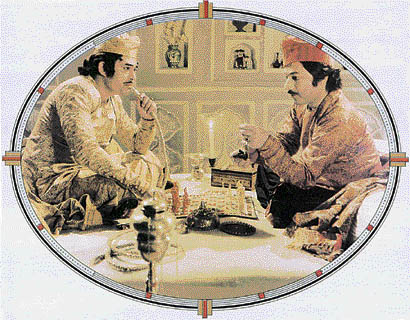
                                                                       

       A scene from Satyajit Ray's film 


                 The Chess Players

                  (शतरंज के खिलाड़ी)


It was in the times of Wajid Ali Shah. Lucknow was drowned in sensuality. The big and small, the rich and the poor – all were sunk in it. Some were engrossed in dance and music; some just revelled in the drowsiness induced by opium. Love of pleasure dominated every aspect of life. In administration, in literature, in social life, in arts and crafts, in business and industry, in cuisine and custom – sensuality ruled everywhere. The state officials were absorbed in fun and pleasure, poets in descriptions of love and separation, artisans in zari and chikan work, businessmen in dealings in surma, perfumes and cosmetics. All were drowned in sensual pleasures. No one knew what was happening around the world. Quail fights were on. Rings were being readied for partridge fights. Somewhere the game of chausar was being played, with its attendant shouts on the winning throw. Elsewhere a pitched chessboard battle was on.  From the king to the pauper – all were engrossed in these pleasures. So much so, that if beggars received money in alms, they preferred to spend it on opium or its extract rather than bread. ‘Playing games like chess or cards or ganjifa sharpens the mind, improves mental faculties and helps in solving complex problems.’ Such arguments were being forcefully advanced. (People subscribing to this thesis can be found even today.) So if Mirza Sajjad Ali and Mir Roshan Ali spent most of their time sharpening their wits, how could any thoughtful person take exception. Both of them were hereditary Jagirdars, free from the worries of a livelihood; they enjoyed their good food without having to work at all. What else could they do?

Every morning, after breakfast, both the friends would spread the chessboard, set up the pieces and  engage themselves in the tactics of chessboard warfare. They would forget whether it was noon, afternoon or evening. Repeated messages from inside that food was ready were ignored, and the cook was forced to serve food right there in the room, as the two friends continued their play. There were no elders in Mirza Sajjad Ali’s family; as a result the game was played in his dewan khana. However, members of Mirza’s family were far from pleased. Not to speak of the family, even the neighbours and servants made uncharitable comments: ‘This is an inauspicious game and can ruin families. God forbid that anyone should get addicted, for it makes a person unfit to do anything.  It’s a serious disease.’ Mirza’s begum was so hostile to the game that she would seek out occasions to berate her husband. But she rarely got this opportunity. The game would begin while she was still asleep, and Mirza would come inside only when she had gone to sleep. However, she would expend her ire upon the servants. ‘Are they asking for paan?  Tell them to come and take it themselves. Have they no time for food? Go and throw it to them. Let them eat or cast it to the dogs.’ But face to face she was helpless. She wasn’t resentful against her husband so much as against his friend, Mir sahib. She had named him Mir, the spoilsport. It is possible Mirza, to save his own skin, also threw all the blame on Mir sahib.

One day the begum had a severe headache. She said to her maid, ‘Go and call Mirza sahib. They should go and bring medicine from a hakim. Run, be quick.’.  Mirza sent the maid back saying he would follow. The begum was hot-tempered. She lost her patience. How could her husband play chess while she had a headache?  Her face became red with anger. She said to the maid, ‘Go and tell them to come immediately, or I shall go to the hakim by myself.’ Mirza was in the midst of a very absorbing game. Mir sahib would be checkmated just in two moves. He spoke in irritation, ‘Is she on her last breath? Why can’t she wait?’  

Mir sahib interjected, ‘Why don’t you go? Women are delicate things.’

Mirza retorted, ‘Oh yes, you want me to go because you’re facing defeat in the next two moves.’

Mir said, ‘My dear, don’t be under any illusion. I have thought of a counter move that’ll turn the tables on you. Go and attend to her. Why are you hurting her?’

‘I won’t go until I have checkmated you.’

 ‘I won’t make any moves. Go and attend to her.’

 ‘My dear, I’ll have to go to a hakim. There’s no headache. This is just pretence to harass me.’

‘Whatever it is, you’ll have to go.’

‘All right. Let me make one more move.’

 ‘Not at all. I won’t touch my pieces until you have gone and talked to her.’

When Mirza sahib went in, the begum changed her tactics and said, groaning with pain, ‘You love this wretched game so much that you don’t care even if I am dying. What kind of a man are you?’

Mirza replied, ‘What could I do? Mir sahib wouldn’t let me go.’

‘Does he think all are as idle as he. He too has a family. Or has he finished them off ?’ 
 
‘He’s such an addict. Whenever he comes I am forced to play.’

‘Why don’t you drive him away?’

‘He is my equal in age, and two fingers higher in rank. I have to oblige him.’

‘Ok, then I shall drive him away. What if he is offended? Does he feed us? Oh Haria, go and pick up the chessboard. And tell Mir sahib that Mirza sahib won’t play anymore. Tell him to go home.’

‘No, no! Don’t do anything of the kind. Would you have me humiliated?  Oh Haria, stop. Don’t go.’

‘Why don’t you let her go? Anyone who stops her will drink my blood.  All right, you stopped her. Let me see how you stop me.’

Saying this begum sahiba advanced angrily towards the dewvan khana. Mirza’s face turned pale. He began to plead with her. ‘For God’s sake. I bind you in  the name of Hazrat Hussain. You would see me dead if you went there.’ But the begum was in no mood to listen. She walked up to the dewan khana, but she stopped. She wouldn’t go in, in the presence of an outsider. She looked in but there was no one there. Mir sahib had displaced a few pieces on the board and had gone out for a stroll to show his innocence. The begum went inside and overturned the chessboard, threw some chessmen under the dewan and a few others out through the door. Then she shut the door and bolted it from inside. Mir sahib saw the chessmen being thrown out and heard the sound of bangles, and the door being bolted. Realizing that the begum was inflamed he slnnk away.

Mirza sahib said to his begum, ‘You’ve been terrible.’

The begum retorted, ‘If Mir sahib comes here, I shall drive him away from the doorsteps. Had he devoted himself to God like this he would have become a saint. You keep playing chess and I remain enslaved to the domestic chores. Are you going to the hakim, or are you still unwilling?’

Mirza came out, but instead of going to the hakim he went straight to Mir sahib’s and narrated the whole story.

Mir sahib replied, ‘When I saw the chessmen being thrown out, I understood everything and ran. She seems so hot-tempered! But you have pampered her so much. This is not good. Why should she bother what you do outside? It is her duty to manage the household. Why should she worry about what you do?’  

‘Never mind,’ said Mirza, ‘Where shall we play now?’

“Why worry? This is a big house. We can play anywhere here.’

‘But how shall I make the begum accept this? When I sat at home she kept on creating trouble. Now if I sit here she won’t let me breathe.’

“Let her shout. She’ll get used to it in a few days. But from now onwards be a little tough with her.’

2

For some unknown reason Mir sahib’s begum preferred to have her husband away from home. That’s why she never objected to Mir sahib’s love of chess, so much so that if Mir sahib delayed going out she would remind him. Because of this Mir sahib was under the illusion that his wife was very courteous and sober. But when the chessboard was spread in the devan khana and Mir sahib stopped going out, the begum became edgy. Her freedom was curtailed. She hardly had any chance to have a glimpse of the outside.

And there was murmuring and whispering among the servants. Up till now they had sat idle, warding off flies. They were never bothered by guests. But now they had to take orders the whole day. Now to fetch paans, now sweets. And the hookah kept smouldering like a lover’s heart. They would go and complain to begum sahiba. ‘Mirza sahib’s chess has become a nuisance. Running about to execute orders, our feet are blistered. What sort of a game is this that goes on from morning till evening! It should be enough to play a game for an hour or two. But we can’t complain. We’re his slaves and have to obey the orders. But this game is evil. The person playing it never prospers. A misfortune is bound to fall upon such a house. So much so that we have seen whole neighbourhoods being ruined one after the other. Everyone in the neighbourhood is talking about it. We’re his faithful servants and don’t like to hear him maligned.’ On this begum sahiba would say, ‘I also don’t like this. But he doesn’t listen to anyone. What can I do?’

In the neighborhood there were a few people of the old school. They had begun to foresee many unhappy consequences. ‘Nothing good will come of it. When our aristocracy is behaving in this manner, God alone can save the country. This kingdom will be ruined because of this game. It’s an evil sign.’

And indeed there was great disorder in the kingdom. People were being robbed in broad daylight. There was no one who could listen to their complaints. All the wealth from the countryside was being sucked into Lucknow and blown on prostitutes, buffoons and in sensual pleasures. The blanket of debt to the English Company was becoming wetter and heavier every day. Because of the absence of good administration taxes were not being collected fully. The Resident was constantly threatening but people were so drenched in voluptuous pleasures, that not a flea tickled their ears.

Nevertheless, months passed and the game of chess went on in Mir sahib’s dewan khana. Newest strategies were being charted, newest castling moves devised. There would be arguments and accusations, but soon the two friends would be reconciled. Sometimes the game would be terminated midway, and the estranged Mirza sahib would walkout and go home, and Mir sahib would go inside. But the night’s sleep would dissolve yesterday’s resentment and the two friends would be back in the dewan khana.  

One day the two friends were submerged in the quicksand of chess when an officer of the king’s army came riding on a horse asking for Mir sahib. Mir sahib was stunned. What was this? Why these summons? This was no good. He shut the doors and said to the servant, ‘Tell him I’m not at home.’

“Where’s he, if not at home?’ asked the rider.

‘I don’t know. What’s the matter?’ asked the servant.

‘I can’t tell you. He has been summoned. May be, he has to provide some soldiers for the king’s army. Jagirdari is no fun. If he has to go to the battlefield, he’ll know what it is.’

‘All right, your message will be delivered.’

‘It’s not that. I shall come again. I have been ordered to bring him along personally.’

The rider went away. Mir sahib was terrified. He said to Mirza sahib, ‘Now, tell me what to do?’

‘It’s big trouble. Even I may be summoned.’

‘He said he would come again.’

‘This is a calamity. What else! If we have to go to the battlefield we would meet an untimely death.’   

 ‘There’s only one way out. They should not find us at home. We can spread our board somewhere on a lonely spot on the bank of Gomti. No one will know. And the fellow will return empty-handed.’

‘Wonderful! Nothing can be better than this.’

And here at home Mir’s begum sad to the rider, ‘You’ve given him a good rebuke.’

The rider said, ‘I know how to make such fools dance to the click of my fingers. All their sense and courage has been eaten away by chess. Now they won’t stay at home even by mistake.’


3

From the next day both the friends would leave their homes before dawn. With a small mat under their arms, holding a box-full of paans the two friends would make their way across the river Gomti to an old deserted mosque that had been built perhaps by Asaf-ud-Daula. On their way they would buy tobacco, a chillum and wine; and they would enter the mosque, spread their mats, light their hookah and start playing. Then they would forget the world. No other words except ‘check’ and ‘mate’ would come out of their mouths. No yogi would be so focused in his meditations as these two. When in the afternoon they felt hungry they would go to an eatery and eat something; smoke their hookah for a while and then restart their play. Sometimes they would forget even to eat.

On the other side, the political situation in the kingdom was deteriorating every day. The Company’s forces were advancing upon Lucknow. The city was in a great turmoil. People were fleeing to the villages with their families. But our two players were unconcerned. They came out of their houses and sneaked through narrow lanes, hiding themselves from the eyes of the king’s men. They wanted to enjoy the benefits from their Jagirs yielding thousands of rupees annually by doing nothing in return. 
  
One day both the friends were playing chess sitting in the decrepit mosque. Mirza’s position was somewhat weak. Mir sahib was threatening him with ‘check’ after ‘check’. In the meantime they saw the soldiers of the Company passing by. It was the gora army moving towards Lucknow to capture the city.

Mir sahib said, ‘The English army is advancing. God be kind.’

Mirza said, ‘Let it come. Check. Save your king.’

‘Let’s watch. Let’s stand in a corner.’

‘Do that later. What’s the hurry? Check.’

‘They have the artillery too. There must be some five thousand men. Their faces red like monkeys! One is afraid to look at them.’

Janaab, don’t make excuses. Don’t use these ruses. Check.’

‘You’re a strange man. Here the city is in danger, and you’re only thinking of “check and mate”. Have you thought how we shall go home if the city is besieged?’

‘We shall see when it is time to go.  Here is check.  And mate.’

The army marched away. It was ten o’clock. A new game was set up.

Mirza said, ‘Where shall we eat?’

‘It’s a roza day today. Are you feeling very hungry?’

‘Oh, no. God knows what’s going on in the city!’

 ‘Everything must be as usual. People must have eaten and would be sleeping peacefully. Nawab sahib must be having fun in his harem.’ 

Both of them set up another game. It was three in the afternoon. This time Mirza’s position was shaky. The four o’clock bell was ringing as they heard the sound of the army’s return. Nawab Wajid Ali had been captured and the army was escorting him to an unknown destination. There was no commotion in the city, and no fighting. No bloodshed. Nowhere the king of a free country would have been vanquished so quietly, without any bloodshed. It wasn’t the kind of non-violence that would please the gods. It was a form of cowardice on which even great cowards would have shed tears. The king of a vast country like Awadh was being driven away as a prisoner, and the city of Lucknow was sleeping peacefully. This was the nether of political downfall.

Mirza said, ‘The tyrants have captured Nawab sahib.’

‘Never mind. Save your king.’    

‘Wait a minute, janaab. I can’t concentrate at the moment. Poor Nawab sahib must be shedding tears of blood.’

‘He should. He won’t enjoy these luxuries there. Check.’

‘All days are not the same. What a painful situation!’

‘That’s true. Here, check again. Now it’s mate. There’s no escape for you.’

‘By God, you’re so cruel. You are unmoved even after such a great calamity. Oh, poor Wajid Ali Shah!’

‘First you save your own king. Mourn for Wajid Ali Shah later. Here’s check and mate. Give me your hand.’


The army marched away with the king as their prisoner. Mirza laid another game as soon as they were gone. Defeat is always painful. Mir said, ‘Come on, let us sing an elegy to mourn Nawab sahib’s fall.’ But Mirza’s loyalty to the king had disappeared with his defeat. He was bent upon taking revenge.


4

It was evening. In the ruins the bats had begun to flutter and scream. The swallows had returned to their nests. But the two players were still playing, as if two bloodthirsty warriors were engaged in a mortal combat. Mirza had lost three successive games and the fourth one too didn’t seem to be going his way. He was playing with the determination and caution, but each time some move somehow went wrong and weakened his position.  His desire for revenge was sharpened with each defeat. On the other hand, Mir sahib was bursting into ghazals, and teasing Mirza sahib, as if he had unearthed a secret treasure. Mirza sahib was irritated but he would utter words of praise for Mir sahib to overcome his embarrassment. But as his position progressively weakened he was losing his patience, so much so that he was losing control over himself. ‘Now don’t change your move again and again. What’s this? You make a move and then change it. Make your move only once. Don’t touch a piece unless you are moving it. You’re taking too much time. This is against the rules. If someone takes more than five minutes to make a move he should be treated as the loser. Now you changed your move again. Please put the piece back.’

Mir sahib’s vazir was about to be taken. He said, ‘I haven’t moved yet.’

‘You’ve made your move. Please put the piece back where it was.’

‘Why should I put it back? I had never let it go from my hand.’

‘If you don’t let go your piece till eternity, does it mean you haven’t moved it? Now when your vazir is being taken you have started cheating.’

‘It is you who is cheating. Winning or losing is by luck. No one wins by cheating.’

‘Then, you have been checkmated in this game.’

“Why have I been checkmated?’

‘Ok, then replace the piece in the same square.’

‘Why? I won’t do it.’

‘Why not? You’ll have to.’  
 
Tempers were rising. Both were unwilling to yield. Then the argument took a different turn. Mirza said, ‘You would have known the rules if someone had played chess in your family. Your ancestors were grass-cutters. How could you learn to play chess? Nobility is something different. One does not become a nobleman just by receiving a jagir.’

‘What? It is your father who must have been a grass-cutter. In our family we have been playing chess for generations.’

‘Oh leave it. You have spent your life working as a cook at Gazi-ud-din’s.  To become a nobleman is no joke.’

‘Why are you blackening the faces of your ancestors? They must have been cooks. Our family has always dined with kings.’

‘You grass-cutter, don’t make tall claims.’

‘Hold your tongue. I’m not used to listening to this kind of language. If someone stares at me I pluck out his eyes. I dare you.’

‘You want to test my courage? All right, let us test each other’s to the end.’

‘I’m not afraid of you.’

Both the friends drew their swords from their hips. It was the age of chivalry. Everyone was equipped with a sword or a dagger. Both friends were pleasure-loving but no cowards. They had become devoid of political will. Why should they die for kings or kingdoms? But they were not deficient in personal courage. The fight began. There was thrusting and parrying; the swords flashed and clashed. And both, fatally wounded, fell down and died writhing in pain. They who could not spare a single drop of tear for their king died defending their vazirs on the chessboard.

It was getting dark. The pieces still lay on the chessboard. It was as if both the kings sitting on their thrones were shedding tears at the death of these warriors.

Silence reigned all around. The broken arches, the ruined walls and dust-laden pillars of the mosque were watching these corpses and cursing their fate.
                                                                            ---
                                                             
                                                               (Hindi, Madhuri, October 1924)


Friday, May 10, 2013

Premchand's story 'Poos Ki Raat' in translation

Here is Premchand's story Poos Ki Raat  translated by me.


                             A Winter Night 
                          (Poos Ki Raat)
                                         

Halku came in and said to his wife, ‘Sahna is at the door. Come on, give me the money you have. Let me pay him and be rid of the noose.’

His wife, Munni, was sweeping the floor. She turned her face towards him and said, ‘Three rupees is all I have. If we give these up, how shall you buy a blanket? How’ll you face the winter nights guarding the crop. Tell him, we shall pay at the time of harvest. Not now.’

Halku stood quietly for a moment, unsure of himself. The month of Poos, the peak of winter, was at hand and he won’t be able to sleep out in the field without a blanket. But Sahna won’t relent. He will threaten and curse. It was better to face the winter somehow and be rid of this trouble.  Halku , carrying his heavy weight (which disproved his name which meant ‘light- weight’), moved towards his wife and said in a cajoling voice, ‘Come on, please give me the money. Let me get rid of this. I shall find a blanket somehow.’

Munni moved away from him, arching her eyes. ‘What’ll you do?  Will someone give you a blanket in charity? God knows how much more we owe him. There’s no end to it. I say, stop tilling the land. Kill yourself toiling, and when the harvest is ready, hand it over to him. That’s the end. We’re born to remain under debt. And then slave as a labour to fill our stomach. What use is this tillage? I won’t give you the money. I won’t.’

‘So I should face the insults?’ Halku said in a melancholy tone.

‘How can he insult you? Is he the king?’ shouted Munni.

But the taut eyebrows were lowered just as she uttered these words. There was a bitter truth in Halku’s words that stared at them like a fierce animal.

She went up to the nich in the wall, took out the rupees and placed them on Halku’s palm. ‘You stop tilling the land. We shall feed ourselves through our daily labour peacefuly. And we won’t have to face the insults. What sort of tilling is this? Earn something by labouring and push that too into this fire. And over and above, this bullying.

Halku walked out with the money as if he was going to tear his own heart out and hand it over to someone. He had saved these three rupees bit by bit out of his daily wages for buying a blanket. He was losing them today. With each step he took his mind was sinking under the weight of his helplessness.


2

A dark night in the winter’s month of Poos! Even the stars seemed to be shivering with cold. Halku lay at one edge of his field on a bamboo-stick cot under the sugar cane-leaf shelter, wrapped in an old thick cotton sheet, shaking with cold. Under the cot sat his pet dog Jabra with his mouth pushed into his body, whining. Neither of them was able to sleep.  

Halku folded his knees up to his mouth and said to Jabra, ‘Are you feeling cold? I had told you to sleep under the pual (a pile of paddy husk) at home. Why did you come here? Now face it. What can I do!  You followed me thinking I was coming here to feast on halwa-poori.  Now go and call your grandmother for help.’

Jabra wagged his tail, and letting out a long whine he stretched his body once and then became silent. Perhaps his dog-sense had told him that his master was unable to sleep because of his cries. 

Halku stretched his hand to caress Jabra’s cold body and said, ‘Don’t come tomorrow, or you will go cold for ever. God alone knows wherefrom this bastardly west wind is bringing in this iciness. Let me light another chillum. The night must be passed somehow. I have already smoked eight. This is the pleasure of being a peasant! There are many so fortunate that if the cold came near them it would be driven away by heat. Thick quilts, sheets, and blankets! The cold dare not come near them. How strange life is! We labour, others enjoy at our cost.

Halku got up and filled up his chillum with a cinder from the pit. Jabra also stood up.

As he smoked, Halku said to Jabra, ‘Would you have a go at the chillum? It doesn’t drive away the cold, but it eases the mind a little bit.’

Jabra looked towards Halku, his eyes overflowing with love.  
    
‘Face this cold for this night. Tomorrow I shall spread a pual for you, and you can sit covered under it. Then you won’t feel the cold.’

Jabra placed his front legs on Halku’s knees and brought his mouth close to Halku’s mouth. Halku could feel his warm breath. 

After smoking his chillum Halku lay down again with the determination to sleep this time. But his body began to shiver in no time. He would turn and twist now on this, then on that side, but the cold had caught hold of his body like an evil spirit.


When he could do nothing to ward off the cold, he gently lifted Jabra, patted his head and made him lie down in his lap. The dog stank awfully, but by holding the animal so close to his body Halku was experiencing a kind of contentment he had not felt for months. Jabra was perhaps feeling that this was the very heaven; and in Halku’s pure heart there was no trace of any aversion towards the dog. He would not have embraced his dearest friend or the nearest relative with such affection! His abject plight that had driven him to this situation hurt him no longer. No, this strange friendship had expanded his spirit in all directions, and every pore in his body was shining brilliantly.


Suddenly Jabra heard the footsteps of an animal. This rare show of affection had infused such a new spirit in him that he thought nothing of the blasts of the cold wind. He got up out of the shed and began to bark vigorously. Halku tried to coax him to come back to him but Jabra did not turn. He kept on running around in the field, barking. He would return for a moment but go back at once. Duty was spilling out of his heart like an unsatisfied desire.  


3
      
 Another hour passed. The night began to pulsate with draughts of cold wind. Halku sat up. He folded his legs and brought his knees on to his chest and hid his head in them. This gave him no respite from cold. He felt as if the blood in his body had frozen, and ice was flowing through his blood vessels. He looked up at the sky to check how far the night had gone. The constellation Saptarishi was still half-way up. It will be dawn only when the constellation reached directly above. More than one fourth of the night still remained.

There was a mango orchard at stone's throw from Halku’s field. It was the time when leaves fall off. There was a heap of dry leaves in the orchard. Halku thought of collecting them and lighting a fire to get some warmth. He was reflecting: If someone saw him gathering the leaves here, he might take him for a ghost. Who knows some animal might be hiding in them. But now it was impossible to stand this cold.

He went into the neighbouring arhar field, uprooted a few stalks and tied them together to make a broom. He picked up a piece of smouldering dung cake and began to walk towards the orchard. Jabra saw him and came to him and started wagging his tail.

Halku said, ‘I can stand it no more. Come, Jabru, let’s go to the orchard, gather some leaves and burn them to get some warmth. When we have warmed ourselves a little we shall come back and sleep. The night is still long.

Jabra whined his assent and began to walk in front towards the orchard.

It was pitch-dark in the orchard; and the cruel wind was blowing across, mercilessly trampling upon the leaves.  Dewdrops were constantly dripping down the trees.

All of a sudden the wind carried towards them a waft of fragrance from henna flowers.

Halku said, ‘What a fine smell, Jabru! Doesn’t it tickle your nose?’

Jabru had found a bone and was gnawing at it.

Halku put the smouldering piece of dung cake on the ground and began to gather leaves around it. In no time he had collected a big heap. His hands were stiff with cold. His bare feet were dissolving. And he was raising a mountain of leaves, lighting which he was going to incinerate this cold.

The fire came alive in a short while. The flames leapt out of it to touch the tree above. In the flickering flames of the fire, it appeared as if the trees in the orchard were carrying the unbounded darkness on their heads. In this limitless sea of darkness this light seemed to be rocking and dancing like a boat.

Halku was sitting in front of the fire warming himself. Soon he took the cloth sheet off his body, tucked it in one of his armpits, and spread out his legs, as if he was provoking the cold. ‘Come on, do what you can.’ Having conquered the infinite power of cold, he was unable to repress his triumph. 

He said to Jabra, ‘Are you still feeling cold?’

Jabra whined, as if to say, ‘Shall we go on feeling cold for ever?’

‘We didn’t think of this, otherwise why should we have suffered so much.’

Jabra wagged his tail.

‘Come on, let’s jump over this fire and see who can cross over. And son, if you burn yourself I won’t get you any treatment.’

Jabra looked at the fire with frightened eyes. 

“And don’t tell Munni about it, or there would be a fight.’

Saying this he jumped cleanly over the fire, just grazing the flames but without any harm. Jabra only circled round the fire, and then came and stood beside him.

Halku said, ‘Come, come, this is not right. Now jump.’ Saying this, he jumped over the fire again and came over to the other side.


4

The leaves had burnt out. Once again the orchard was stark dark. The fire was still alive under the ashes; and ruffled by draughts of wind, it would peep out momentarily, and then close its eyes.

Halku once again wrapped the sheet round himself, and sitting beside the still warm ashes he began to hum a song. His body had warmed up but as the cold around him began to envelop him he was sinking into a state of torpor.   

Jabru barked angrily and ran towards the field. Halku thought that a herd of animals had invaded his field. Perhaps it was a herd of neelgais. He could clearly hear the noise of their running and tramping around; and then it looked they were grazing in the field for he could hear the sound of munching.

‘No.’ For a moment he thought, ‘No no animal can enter the field in the presence of Jabra. He would bite them away. i'm only imagining.  I don't hear anything now. I was mistaken.'

He shouted loudly for Jabra.

Jabra kept on barking and did not come to him.

Then again he heard the sound of animals grazing. He could deceive himself no longer. Moving from his seat looked like poison. How cosily he was sitting! In this cold entering the field and chasing the animals seemed foolhardy. He did not move.

He shouted loudly, ‘Liho! Liho! Liho!’

Jabra barked again. The animals were devouring the field. The harvest is ready. And what a good harvest! But these villainous animals are going to destroy it.

Halku got up with determination and walked a few steps. But all of a sudden a draught of wind, biting like the sting of a scorpion, overwhelmed him and he returned to the dying fire and began scouring through the ashes to get some warmth.

Jabra was barking himself hoarse, the neelgais were cleaning out the field, and Halku was sitting beside the warm ashes with a calm resignation. Listlessness had bound him hand and foot.

He covered himself in his sheet went to sleep, close to the ashes.

When he woke in the morning there was sunshine all around, and Munni was waking him up, ‘Will you keep sleeping today? You are lying here in bliss, and there the crop has been destroyed.’

Halku woke up and said, ‘Have you been to the field?’    

‘Yes’, she said, ‘The whole crop has been ruined. Who sleeps like this? How did your camping here all night help?’

Halku reeled off an excuse, ‘Here I was dying, and you’re worried about the crop. I had such a severe stomach ache!’

Both walked to their field. They saw the whole crop trampled upon, and Jabru lying under the shed almost lifeless.

Both of them were looking at their field. Munni was sad, but Halku was happy.

Munni said, ‘Now, to pay the tax we shall have to work as daily wagers.’

Halku replied, ‘So what? I won’t have to sleep here on a cold night.’  

                                                               ---
(Hindi, Madhuri, May 1930)


Sunday, April 7, 2013

Premchand's story 'Namak Ka Daroga' in translation


Here is a translation of Premchand's story: Namak Ka Daroga.


                                     THE SALT INSPECTOR   
                                      (Namak Ka Daroga)   


When a new department banning open trade in salt (a free gift of God) was set up, people began to  trade it illegally. Many crooked ways were invented: Some took to bribing, others to smuggling. The government officials had a great time. People gave up the universally honoured office of the patwari and turned to this department. Even the lawyers hankered after the salt inspector’s post.  It was a time when people regarded the English education synonymous with Christianity. Persian was the dominant language; and Persian-knowing persons, well-read in love stories and erotic literature, were able to get appointed to the highest posts. Munshi Vanshidhar, too, having read the unrequited love story of Zulaikha, rating the love stories of Majnu and Farhad far above the achievements of Nal and Neel and the discovery of America, went out in search of employment. His father was a worldly-wise man. He gave the young man the following advice: Son, you well understand our sad plight. We are under a heavy debt. There’re girls in the family, who are growing up fast like weeds. I’m like a tree on the edge that is likely to collapse anytime. Now you’re the master and head of the family. Don’t  bother about status in a profession, which  is like the mausoleum of a pir. Your eyes should always be fixed on offerings and chadders. Look for a job with an ‘over-and-above-the-salary’ income. The monthly salary is like the full moon  which is visible only for a day, and wanes each successive day and then disappears. The over-and-above income is like a flowing stream that regularly quenches your thirst. Salary is given by man, that’s why it does not take you far; the over-and-above  income is the gift of God, which leads to prosperity. You are a scholar yourself and don’t need to be taught anything. One needs to use one’s understanding. Think of man and his needs, and his opportunities. Then do what you think is best. It always pays to be tough with a person needing favours from you. But it is difficult to tame one who does not need any favour. Keep all this always in front of your eyes. This is my lifetime’s accumulation.’

After this sermon the father gave his blessings. Vanshidhar was an obedient son. He listened attentively to all this and then walked out of his home. In this vast world perseverance was his friend, intelligence his guide and self-reliance his aid. But since he had an auspicious start, he was appointed to the post of salt inspector as soon as he had stepped out. The salary was good, and there was no limit to over-and-above  income. When the old Munshi received this happy news his joy knew no bounds. His creditors became a bit soft and the hope of old revelries revived. Thorns began to prick the neighbours’ hearts.


2
It was a winter night. The constables and watchmen of the Salt Department were dead drunk. Munshi Vanshidhar had been here only for six months but he had impressed his officers with his efficiency and spotless conduct. They had begun to trust him wholeheartedly. The river Jamuna flowed about a mile away from the office of the Salt Department, where there was a boat-bridge over the river. The inspector had shut the doors and was sound asleep. Suddenly he woke up and heard, instead of the sound of the flowing river, the clatter of bullock carts and the shouts of boatmen. He wondered why carts were going across the river at this hour. Surely there was something fishy. A moment’s reflection strengthened his suspicions. He got up and immediately put on his uniform, put his pistol in his pocket and rode his horse and arrived at the river bridge in no time. He saw a long line of bullock carts going across the bridge. He demanded, ‘Whose carts are these?’

There was no answer for some time. Then after  some whispering among the men,  one of them said, ‘Pandit Alopidin’s.’
‘Who’s Pandit Alopidin?’
‘Of Daatagunj.’
Munshi Vanshidhar was taken aback. Pandit Alopidin was the  most prominent zamindar of this area. He had a turnover of lakhs, and there was no trader, big or small, who was not under his obligation. He had a huge business, and was a skilful manipulator. English officers came to his area for hunting as his guests. This hospitality went on  round the year.
The inspector asked, ‘Where are the carts headed to?’
‘Kanpur.’ 
When he asked what was loaded in them there was a stunning silence. The inspector’s suspicions were mounting. When he did not get any reply he shouted, ‘Are you all dumb? Tell me what’s inside these carts.’ 

When he got no reply even after this, he moved his horse close to one of the carts to examine the load. His suspicions were confirmed. This was salt indeed.

3
Pandit Alopidin  was following the convoy in his well bedecked chariot, lying half asleep and half awake. All of a sudden a few rattled-up cart drivers came and woke him up. ‘Maharaj, the inspector has stopped the carts. He’s at the river bank  and has summoned you.’
Pandit Alopidin had unshakable faith in the goddess Lakshmi. He used to say that not only on earth, the goddess Lakshmi reigned even in heaven. This was the plain truth. Justice and policy, both are playthings of Lakshmi. She can make them dance to any tune. Still lying in the same posture, he spoke with great confidence, ‘Go, I’m coming.’
After this Panditji  rolled a paan for himself with great nonchalance. Covering himself in a quilt he walked towards the inspector and said, ‘God bless you, babuji. Tell me how I have erred that the carts have been stopped. You should be kind to us brahmins.’
Vanshidhar said brusquely, ‘By the government order.’
Pandit Alopidin laughed and said, ‘We don’t know ‘the government order’, or the government. For us you’re the government. It’s all between us, our family affair. How can we be outsiders? You needn’t have taken this trouble. It’s impossible we should pass this way and go away without making an offering to the god of this ghat. I was just coming to present myself before you.’
Vanshidhar remained unmoved by this beguiling tune from the flute of wealth. New to his job, he was riding on the wave of honesty. He spoke in a harsh tone, ‘I’m not one of those namakharams who would sell their honour  for  a few  coweries. You’re under arrest now. You’ll be challaned under the law. I don’t have time to waste. Jamadaar Badlu Singh, take him into custody and bring him along. This is my order.’
Panditji was dumbfounded; the cart drivers were at sixes and sevens. This was the first time ever in his life that Panditji had to listen to such rude talk. Badlu Singh moved forward but did not have the courage to hold Panditji’s hand. Panditji had never seen dharma insulting artha in such a manner. He thought the inspector was  being rude and unmannerly, having not yet succumbed to temptation. He is too young and hesitant. Pandit Alopidin played a very humble tune. ‘Babu sahib, don’t do this. I’ll be ruined. My reputation will roll in dust. What‘ll you gain by insulting me ? I’m not a stranger to you in anyway.’

Vanshidhar answered rudely. ‘I don’t want to hear all this.’

The ground that Alopidin thought was rock solid appeared to be slipping from under his feet. Both prestige  and wealth had been hit hard; but even then he had full faith in the numerical strength of wealth. He said to his assistant, ‘Offer one thousand rupees to the sahib. He’s behaving like a hungry lion.’
Vanshidhar became angry. ‘Forget one thousand, even one lakh won’t shake me from the path of truth.’
Panditji was annoyed at dharma’s blind stubbornness, and this renunciation rare even among gods. Both the powers now engaged in warfare. Artha began to push larger numbers into the attack.  From one to five, from five to ten,  from ten to fifteen,  and from fifteen it reached to twenty thousand. But dharma with its superhuman bravery stood unshaken like a mountain against this vast numerical strength.
  
Alopidin was helpless now. He said, ‘I can’t go beyond this. You may do whatever you like.’
Vanshidhar shouted at the Jamadar. Badlu Singh advanced towards Pandit Alopidin, cursing the inspector in his heart. Panditji  drew back in fright. He spoke with great humility, ‘Babu sahib, for God’s sake have pity on me. I’m willing to settle it for twenty five thousand.’
‘It’s impossible.’
‘Thirty thousand.’
‘No way.’
‘Not even at forty thousand?’
‘Not even forty lakhs. It’s impossible. Badlu Singh  take this man into custody immediately. I don’t want to hear another word.’
Dharma had trampled artha under foot. Alopidin saw a strong man advancing towards him with handcuffs. He looked around helplessly with pleading eyes. Then he fell down in a swoon.

4
The world was asleep but its tongue was wagging. In the morning the same story was on everyone’s lips, the young-n-old. Everybody was commenting on Panditji’s conduct; condemnation came in showers from all sides, as if  the world had been finally rid of sinners and sinfulness. Milkman who adulterated milk, officials who made false entries in their diaries, babus who travelled ticketless, moneylenders and traders who concocted fraudulent documents – all were  shaking their heads like gods.  The next day when Pandit Alopidin, handcuffed and flanked by constables, his heart filled with remorse and anger, and his head held down in shame, moved towards the court as an accused, the whole city was rattled. Eyes wouldn’t have been so searching even in fairs.  Roofs and walls had become one with crowds of people.
But the moment Pandit Alopidin reached the court, he became the lion of this impenetrable jungle. The officials were his devotees, the junior staff his  minions, the lawyers his obedient servants, the orderlies, peons and watchmen his voluntary slaves. The moment people saw him they ran towards him from all directions. They were surprised; not that Alopidin had done this deed, but as to how he had let himself be caught in the clutches of the law.  How could a person who had so much money to employ all the possible means and a marvelous gift of the gab be caught like this? Everyone sympathized with him. An army of lawyers was immediately readied to tackle the impending assault. In the battlefield of justice, dharma and  artha were arrayed against each other. Vanshidhar stood there speechless. He had no force except that of truth and no weapons except bare facts. There were witnesses, but they had turned wobbly out of greed.
Vanshidhar had the feeling that even justice had deserted him. It was the court of justice but the staff there were drunk with partiality: Justice and partisanship don’t go together. Where there is partisanship there can be no justice. The trial was over in no time. The Deputy Magistrate wrote in his judgement: ‘The  evidence presented against Pandit Alopidin is false and misleading. He is a prominent person. It is unimaginable that  a person like him would break the law for such a small gain.  Although Inspector Vanshidhar is not to blame too much, yet  his  brazen and thoughtless act has caused needless agony to an honourable man. We are happy that he is watchful and alert in performing his duty but his overboard loyalty has destroyed his reason and judgement. He should be careful in future.’
    
The lawyers leaped with joy when they heard the judgement. Pandit Alopidin came out smiling. The near and dear ones began to rain money all around. The sea of generosity was on a high tide and its waves shook the very foundations of justice. When Vanshidhar came out of the court he was showered with volleys of sarcastic comments from all sides. The peons mockingly bowed their heads and saluted him. But  each and every harsh word or gesture was feeding the fire of his pride. Had he won the case he might not have walked with  a straighter head. Today he underwent a strange realization. Justice and learning, great titles, long beards and loose gowns – none of these was worthy of any respect.

Vanshidhar had antagonized artha. He had to pay the rice. Hardly a week had passed when he received  the letter of suspension. He had been rewarded for performing his duty. Broken-hearted, sad, bewildered, the poor fellow headed homewards. The old Munshi had been fretting and fuming even before this disaster: ‘The boy had turned a deaf ear to his advice and would have his way. Here I should face demands from the wine-seller and the butcher and live like a saint in my old age, and there just the bare salary! I have also been in service and was not holding any rank, but I worked and worked hard. And this man is making a show of his honesty. Never mind if there is darkness at home, he must light a lamp at the mosque. It is unbelievable. All his education has been a waste.’ A few days after this, when Vanshidhar reached home in that sorry state and the old man heard the news he beat his head. He said, ‘I feel like breaking mine and your head.’ He said many harsh words, and if Vanshidhar had not removed himself from his sight, his anger might have turned wild. His old mother was also unhappy. All her plans of pilgrimage to Jagannath and Rameshwaram had turned to dust. His wife too was resentful and would not talk to him for days.
A week passed. It was evening. The old Munshiji was at his prayers. At this very moment an ornamental chariot stopped at his door. Green and red curtains, driven by a pair of bullocks from the western parts, their necks bedecked with blue ropes, their horns capped with copper, escorted by servants carrying lathis on their shoulders. Munshiji ran out to welcome. It was Pandit Alopidin. Munshiji bowed his head in salutation and opened with a gush of admiration: ‘It is our great fortune to see you at our door. You are like a god to us. How can I show you my face, which has been painted black? But what can I do? My son is a luckless black sheep. Otherwise, why should I have to hide my face out of shame. God should keep one issue-less rather than shame one with such a son.’
Alopidin said, ‘No bhai sahib , don’t say all this.’
Munshiji was surprised. ‘What else should I say about such a progeny?’
Alopidin spoke in a voice full of love. ‘People, steadfast in duty and ready to sacrifice everything to preserve their  dharma  and enhance the glory of their family and ancestors, are rare indeed.’
Pandit Alopidin said to Vanshidhar, ‘Inspector sahib, don’t treat this as flattery. I didn’t have to come so far to flatter you. That day you had arrested me on the strength of your authority, but today I have come of my own to be arrested by you. I have met thousands of rich and wealthy. I had dealings with thousands of high officials. I enslaved all of them with my money. You alone have vanquished me. Allow me to say something.’
When Vanshidhar saw Alopidin advancing towards him he  got up and received him  courteously but  with his head held high. He thought this fellow had come to insult  and humiliate him further. He did not try to apologize,  and did not like his father’s fawning attitude. But when he heard what Panditji said, he  forgot all the malice. He cast a fleeting glance on Panditji’s face and saw it radiating sincerity. His pride changed into shame. He said, ‘You’re being very generous in saying all this. Please forgive me for the disrespect I showed you. I was shackled in the chains of dharma, otherwise I’m your humble servant. I am ready to obey your orders.’
Pandit Alopidin said in a humble voice, ‘You did not accept my request at the river bank. But today you will have to do it.’
Vanshidhar said, ‘I can’t be of any use to you, but still I shall  try my best to serve you.’
Alopidin took out a  judicial paper from his pocket and put it before Vanshidhar and said, ‘Accept this position and put your signatures here. I am a brahmin and shall not go away until you agree to this.’
When Vanshidhar read what was written on the paper his eyes were filled with tears out of gratefulness. Panditji had appointed him the manager of all his properties. A salary of six thousand rupees per annum, besides  the daily expenses. A horse to ride, and a bungalow to live, and servants!
Vanshidhar spoke in a trembling voice, ‘Panditji I don’t have the words to praise your generosity, but I’m not fit for such a big position.’
Panditji smiled and said, ‘At this moment I need only an unfit person.’
Vanshidhar replied, ‘I am your humble servant. It will be my good fortune to serve such an honourable and  famous person. But I have neither the education, nor the wisdom, nor the temperament to  make up for my weaknesses. You need an experienced and far-sighted man for this job.’
Alopidin took the pen out of the pen-holder and handed it over to Vanshidhar, saying, ‘I want neither learning, nor  experience, nor farsightedness, nor even expertise. I have already tasted the fruits of these qualities. Now fortune has cast before  me a pearl that outshines the brilliance of the able and the learned. Take this pen, don’t think too much, and sign this paper. I pray to God that he should always keep you as steadfast, fearless and unwavering yet  committed to dharma as you were on the river bank.’
Vanshidhar’s eyes were filled with tears. His small heart could not contain such generosity. Once again he looked at Panditji with devotion and reverence and  signed the contract with a trembling hand.
 Alopidin  embraced him with great joy.  

---

(Urdu, Hamdard, October  1913)


My Comments


 An amazing story, to say the least. 

The story was written in 1910, very early in his career, and just see how perfectly well Premchand understands the nature of Indian (or human) society, and how it seems a story that might have been written today, except perhaps for the ending.

First, Premchand fully understands how imposition of controls by the State (the Inspector Raj) leads to smuggling, black-marketing, tax evasion and corruption. See how the job of the salt inspector is eyed by everyone, especially by the lawyers.

Look at Vanshidhar’s worldly-wise father asking him, blatantly, to fix his eyes on the offerings, on the income over and above the salary, rather than bothering about the rank and status in a job. It seems he is in debts because of his love of good life, eating and drinking.  When he hears that his son has been appointed salt inspector he is delighted and hopes his son would, through his ‘over and above the salary income’, not only relieve him of his debts and help in the marriage of his daughters but also facilitate a life of conviviality in his old age, as in the past. Look at the neighbours, who become green with jealousy when they hear the news of Vanshidhar’s appointment as a salt inspector!

Further, look at the manner the employees of the salt department perform their duties. The watchmen and constables are dead drunk, while still on duty, a common occurring today. Nothing seems to have changed during these hundred years in the way the administration works in the country.

And Pandit Alopidin! He might well be a businessperson of today! His philosophy that it is the goddess Lakshmi who rules on earth as well as in heaven is perfectly in tune with  what the modern-day business community believes in and practises. He is also typical of the modern day businesspersons and politicians, brazen and self-assured in their exercise of power, but in reality cowardly and chicken-hearted when confronted with their crime. Alopidin, having failed to win over Vanshidhar with his offerings, swoons the moment the policeman advances to arrest him. Today’s businesspersons and politicians rush to hospitals with chest pain when they are caught.

Look at the public reaction at Alopidin’s arrest. Everyone enjoys his humiliation, even the milk-seller who adulterates milk, the policemen who makes false diary entries, the ticketless travellers and the fraudulent businessmen. But in the court the scene changes dramatically in Alopidin’s favour. Everyone is on his side: The lawyers, the court officials, the peons, the watchmen and even the magistrate. He is now ‘the lion of this impenetrable jungle.’  Vanshidhar’s witnesses turn hostile, the  case breaks down and Alopidin is acquitted. Strictures  are passed against Vanshidhar. Tables are turned. Artha has triumphed over Dharma. Vanshidhar, like the modern day whistle-blowers, is  isolated and suspended, though luckily not ‘eliminated’, as might have happened today. Even his own family turn against him. His father rues that such a son was ever born to him, that his education had been a waste. His mother too is disappointed for she cannot now go on her pilgrimage to Jagannath and Rameshwaram. And his wife refuses to talk to him.

Premchand has painted a perfect image of a society where Lakshmi is all powerful, even during the times when we could not even think of a consumer society, of conspicuous consumption, and did not see the presence of an infinite variety of goods and pleasures that money can buy today. Worldliness, it seems, is in everyone’s blood.  Premchand says all this with such facility and in his inimitable style laced with humour and irony, while yet probing the human psyche to its very depths.

Look at the marvellous felicity of his expression! Some of his images are magnificent. Girls who ‘grow up like weeds’. A job is like the Mausoleum of a Pir where chaddars and offerings are more important than piety. A salary is like a ‘full moon night’ that lasts only a day and wanes progressively. One might quote many more. Premchand’s volubility is a constantly flowing stream. But there are occasions when the stream overflows  and breaks the bounds of propriety and swells into wordiness. Premchand is sometimes guilty of using too many words. This is one  major weakness in Premchand that seldom deserted him even to the end. Many of his stories lack the tautness of a finished product. All he needed to do was to trim and edit to achieve that perfection. Why he did not, only those who have worked on his texts and circumstances under which he worked and wrote can tell us. Translations often tend to hide this flaw.

But the most important, fascinating and debatable issue in this story is its ending. A present-day story writer might have ended the story at the court with Vanshidhar’s complete humiliation at the hands of our system of justice where Artha completely overwhelms Dharma, highlighting the mockery of justice so characteristic of our times today.

So what to make of the last episode of the story, and the way it ends? It seems to be going totally against the grain of Premchand’s own understanding of human nature. The arrival of Alopidin at Vanshidhar’s house to offer him the position of the manger of his estate, and Vanshidhar’s tame acceptance? In the court Artha had triumphed over Dharma. Here it seems Artha, chastened and transformed, comes to surrender itself before Dharma. Or does it? Can one really believe that Alopidin  has been transformed? But that is how it looks. This is another issue with Premchand. The story ends not  as it should, driven by the logic of what has happened  before, but in the way Premchand thinks it should end. Premchand believes that Artha should subordinate itself to Dharma, for that is the only solution for the problems of corruption, injustice and greed. So it looks an issue between what is and what should be. Premchand most probably chooses what should be.

I would however like to read the story’s ending differently, although a straight forward reading of  the text does not seem to warrant this. Though, just an ironic twist might justify this.

My reading is  that, far from  Artha bowing before Dharma, it is Dharma that surrenders before Artha. Oily-tongued Alopidin attempts to mislead Vanshidhar to believe that he is a changed man  and has given up his Adharmic ways, giving the impression that now onwards he would use his wealth and Vanshidhar’s steadfast honesty only in the service of Dharma. And  Vanshidhar, sensing Alopidin’s real intent, goes a step further in this game of mutual deception, or understanding. Chastised by his father and family, realizing the mistake he had made in disregarding his father’s advice, he now goes all out to accept Alopidin’s  offer, realizing fully well that his arresting Alopidin  has helped him to make a better bargain for himself. He remembers what his father had said to him: It always pays to be tough with a person needing favours from you. From now onwards Vanshidhar will work as a humble servant of Alopidin’s. So the story is not a (wishful) triumph of Dharnma over Artha, but in fact one of abject surrender by Dharma before Artha, in the true spirit of our times. Vanshidhar will now act as a watchdog (and a loyal Munim) over Alopidin ill-earned wealth against many predators and competitors.  Only such an ending is in tune with the rest of the story, and Premchand’s deep and wonderful understanding of our society, where Lakshmi presides.  

Premchand’s idealism, has been regarded as another weakness. The story's ending seems to testify to this charge. But this limitation was self-imposed. Premchand, in his reformist’s zeal, had consciously decided to create characters who are good  and models to be emulated to show that everything is not evil. So it is a self-inflicted ‘weakness’, if it is. In this story he wanted to show that it is possible for even a man like Alopidin to transform himself after he has seen that his wealth has failed to bend  an honest man. This is probable, but only to a very small degree.          
          ---